Lunasol Logistics Lunasol Logistics

What Are the Benefits of China Warehouse Logistics Robots?

Time:2026-10-27 Author:Ethan
0%

China’s warehouse sector is becoming a practical testing ground for logistics robotics. The scale is substantial. According to the National Bureau of Statistics of China, the country’s total social logistics value reached approximately RMB 352.4 trillion in 2023. This volume creates constant pressure for faster, safer, and more predictable warehouse operations.

The question is direct: What Are The Benefits Of Logistics Robots In Warehousing? Industry data provides useful context. The International Federation of Robotics reported 276,288 industrial robot installations in China during 2023, representing about 51% of global installations. These figures do not measure warehouse robots directly, but they show China’s growing automation capability. Interact Analysis has also identified logistics mobile robots as a major growth segment, supported by e-commerce, manufacturing, and third-party logistics demand.

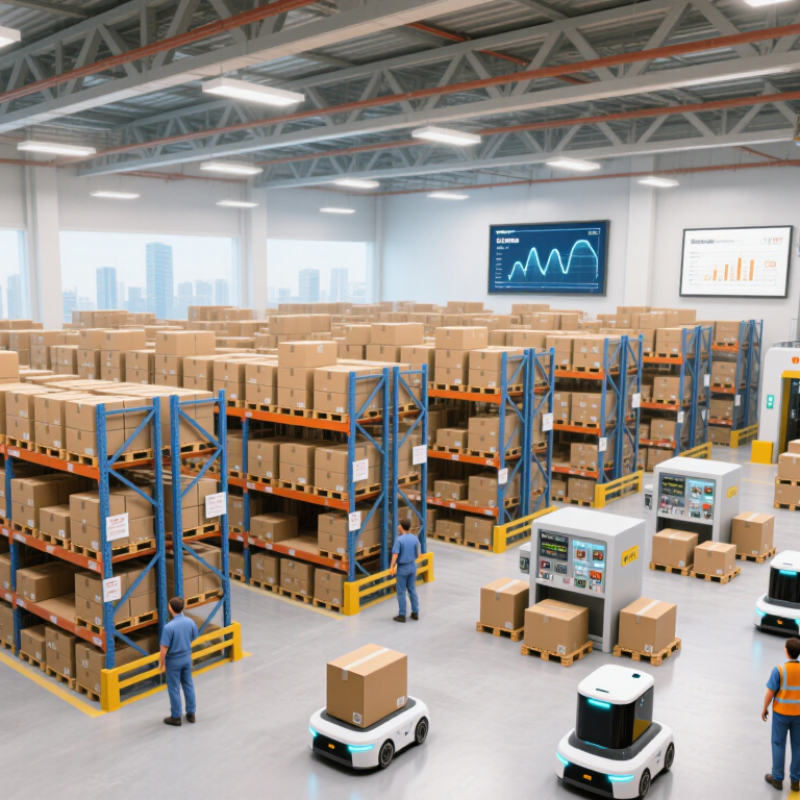
In a Chinese warehouse, autonomous mobile robots can move cartons between storage aisles, picking stations, and loading areas. The movement is visible. Workers spend less time pushing heavy trolleys and more time handling exceptions. Robots can also improve inventory traceability, reduce walking distances, and support extended operating hours. Automated storage systems may use vertical space more effectively, especially where urban warehouse rents are high.

The benefits are not automatic.

A robot fleet needs reliable software, accurate inventory data, safe routes, and trained employees. Poor layout design can create congestion instead of efficiency. A small pilot may also produce impressive results that disappear at full scale. Therefore, companies should compare throughput, error rates, labor conditions, maintenance costs, and payback periods before expanding. This evidence-based approach makes warehouse robotics more credible, rather than treating automation as a fashionable shortcut.
What Are the Benefits of China Warehouse Logistics Robots?

China’s Warehouse Robot Market: Growth, Adoption Rates, and Investment Trends

China’s warehouse robot market is moving from pilot projects toward routine operations. Industry surveys and logistics-site observations show strongest adoption in e-commerce fulfillment, parcel sorting, and cold-chain storage. Autonomous mobile robots carry shelves or bins across facilities, while robotic arms handle repetitive picking. In a busy warehouse, one robot can travel several kilometers per shift. The benefits are practical: faster order movement, steadier output, and fewer lifting tasks.

Adoption remains uneven. Large distribution centers can justify dense fleets, charging stations, and software integration. Smaller warehouses often choose limited deployments because installation costs and staff training remain significant. Publicly reported adoption rates also vary by definition. Some studies count active sites, while others count individual machines. That difference matters. Managers should compare pick accuracy, utilization hours, maintenance calls, and payback periods before expanding.

Investment is becoming more selective. Funding is moving toward navigation software, machine vision, battery systems, and flexible robots for changing layouts. Investors appear less interested in impressive demonstrations without measurable throughput. Yet the market still has rough edges. A robot can stop behind one misplaced carton, creating a costly delay. Human oversight remains essential during peak seasons and layout changes. A cautious assessment suggests China’s growth will depend on reliable integration, not novelty.

What Are the Benefits of China Warehouse Logistics Robots?

China's fast-growing parcel economy is increasing demand for warehouse automation, including autonomous mobile robots, automated storage systems, sorting robots, and robotic picking solutions.

Higher throughput

Robots can move inventory and parcels continuously, helping warehouses handle peak-season demand more efficiently.

Lower operating pressure

Automation reduces repetitive manual handling and helps operators improve labor allocation in high-volume facilities.

Improved accuracy

Sensor-based navigation and software-controlled workflows can reduce picking, sorting, and transportation errors.

Chart data: China's express delivery volume, 2019–2024, reported by China's State Post Bureau. Express volume is shown in billions of parcels and serves as a demand indicator for warehouse logistics automation.

Core Technologies: AMRs, AGVs, AS/RS, and AI Vision in Chinese Warehouses

In modern Chinese warehouses, AMRs and AGVs handle different movement challenges. AMRs use sensors and software to choose routes around workers, pallets, and temporary obstacles. AGVs usually follow magnetic, optical, or mapped paths with predictable accuracy. This division can reduce walking time and keep replenishment tasks moving. In busy facilities, AMRs can deliver totes directly to picking stations. AGVs suit repeated transfers between fixed points. The floor stays flexible.

AS/RS systems place and retrieve cartons or pallets inside dense storage structures. They use cranes, shuttles, or robotic carriers to improve vertical space usage. This design can shorten search time and support accurate inventory records. AI vision adds another layer. Cameras inspect labels, carton shapes, damaged packaging, and empty pallet positions. Vision software can flag unclear barcodes before products enter storage. Data quality matters. Poor lighting, dust, or reflective wrapping can still confuse the system.

Practical deployment requires more than buying robots. Engineers must study aisle width, floor conditions, charging areas, and peak-season traffic. A warehouse may need AMRs in one zone and AGVs in another. That hybrid approach often works better than forcing one technology everywhere. Yet the promise is not perfect. Robot downtime, weak network coverage, and incorrect inventory data can interrupt operations quickly. Staff also need training to manage exceptions, not only normal workflows. Small pilot tests reveal these weaknesses before a full installation.

What Are the Benefits of China Warehouse Logistics Robots? - Core Technologies: AMRs, AGVs, AS/RS, and AI Vision in Chinese Warehouses

Technology Primary Warehouse Function Typical Navigation or Storage Method Typical Payload Range Typical Operating Speed Key Benefits Best-Fit Applications
Autonomous Mobile Robots (AMRs) Goods movement, goods-to-person picking, kitting, replenishment, and order consolidation LiDAR, cameras, inertial sensors, and digital maps; routes can be changed by software 100–1,500 kg 1–2 m/s Flexible deployment, reduced walking distance, scalable fleet operations, and safer human–robot collaboration E-commerce, apparel, electronics, spare parts, and mixed-SKU warehouses
Automated Guided Vehicles (AGVs) 搬运 pallets, bins, racks, and materials along repeatable warehouse routes Magnetic tape, QR codes, reflectors, or fixed laser guidance; routes are more structured than AMR routes 500–2,000 kg 0.8–1.5 m/s Consistent transport, predictable scheduling, lower manual handling, and reliable operation in fixed workflows Manufacturing logistics, pallet transfer, cross-docking, and high-volume line-side supply
Automated Storage and Retrieval Systems (AS/RS) High-density storage, automated put-away, retrieval, buffering, and inventory control Cranes, shuttle systems, lift modules, or robotic storage vehicles operating in dedicated racks Typically 50–1,500 kg per load System-dependent; often 0.5–4 m/s Improved space utilization, accurate inventory location, controlled access, and reduced retrieval labor High-throughput distribution centers, cold storage, pharmaceutical logistics, and dense urban warehouses
AI Vision Systems Barcode reading, dimensioning, item identification, quality inspection, and robotic picking support 2D cameras, 3D cameras, depth sensors, machine learning, and image-recognition algorithms Not applicable Milliseconds to seconds per inspection or scan Faster data capture, fewer picking and shipping errors, automated verification, and better traceability Parcel sortation, inbound receiving, SKU recognition, inventory counting, and quality control
Robotic Picking Systems Piece picking, depalletizing, palletizing, carton handling, and order fulfillment Robot arms combined with machine vision, grippers, conveyors, and warehouse-control software Item-dependent; commonly up to 25 kg per pick Approximately 300–1,200 picks/hour Stable throughput, reduced repetitive work, improved ergonomics, and consistent handling quality Consumer goods, groceries, parcels, electronics, and standardized carton operations
Warehouse Control and AI Optimization Fleet dispatching, task allocation, slotting, route optimization, and exception management Warehouse management systems, warehouse control systems, sensors, operational data, and predictive algorithms Not applicable Real-time or near-real-time decisions Higher equipment utilization, fewer bottlenecks, better peak-season scalability, and data-based decision-making Multi-robot warehouses, high-volume fulfillment, omnichannel distribution, and complex order profiles

Note: Payload, speed, and picking-rate figures are representative industry ranges. Actual performance varies according to robot configuration, load characteristics, aisle layout, safety requirements, software integration, and warehouse operating conditions.

Productivity Gains: Orders per Hour, Picking Accuracy, and Labor Reduction

What Are the Benefits of China Warehouse Logistics Robots?

In busy China warehouses, logistics robots can raise productivity by moving goods between storage, picking, and packing zones. Their value appears clearly in orders completed per hour. A robot can deliver several totes in one route, reducing walking time for pickers. Workers spend more time scanning and selecting products. They spend less time pushing carts.

The first trial is rarely perfect. Aisles may be too narrow. Software settings may also create delays. After route adjustments, many operations report steadier workflows and more consistent hourly output. Picking accuracy can improve because robots guide workers to assigned locations. Scanners confirm item codes and quantities before each tote leaves the station. This reduces common mistakes, such as selecting similar-looking packaging. Accuracy still depends on clean inventory data and disciplined scanning.

Labor reduction does not always mean eliminating jobs. It often means using fewer people for repetitive transport and reallocating staff to quality checks, exception handling, or customer service. For example, one team may manage more orders during evening peaks without adding temporary workers. Supervisors should compare baseline orders per hour, error rates, overtime, and training time. Numbers can look impressive without showing the full cost. Battery charging, maintenance, integration, and operator training require attention. Human judgment remains essential when damaged cartons, unusual orders, or system interruptions occur.

Operational Benefits: 24/7 Throughput, Inventory Accuracy, and Safer Workplaces

What Are the Benefits of China Warehouse Logistics Robots?

China warehouse logistics robots can keep goods moving beyond normal shift hours. They support 24/7 throughput when orders arrive overnight or during seasonal peaks. The 2024 MHI Annual Industry Report found that 83% of supply chain leaders expect to adopt robotics within five years. Still, continuous operation requires charging plans, maintenance windows, and trained supervisors. A poorly mapped route can slow an entire aisle.

83%
of supply chain leaders expect to adopt robotics within five years.

Robots also improve inventory accuracy by recording each movement digitally. They can scan locations, confirm quantities, and reduce manual counting errors. The 2023 Global Warehousing Study reported that 76% of warehouse decision-makers expect greater automation use by 2028. Accuracy depends on clean item data and disciplined exception handling. Technology cannot repair inconsistent receiving practices. It only exposes them faster.

Safer workplaces matter, too. Robots can carry heavy totes and reduce repetitive walking. The U.S. Bureau of Labor Statistics recorded 1,053 fatal work injuries in transportation and material-moving occupations in 2023, showing why risk reduction deserves attention.

1,053
fatal work injuries in transportation and material-moving occupations in 2023

Tips: Start with one high-volume zone. Measure throughput, picking accuracy, downtime, and near misses for 30 days. Review the results with operators. Their practical feedback may reveal problems that dashboards miss.

ROI Evaluation: Payback Period, Total Cost of Ownership, and Scalability

China warehouse logistics robots can improve picking, transport, and inventory movement, but their value depends on measurable operating conditions. A practical ROI review begins with baseline data: orders per hour, labor hours, walking distance, error rates, and peak-season overtime. One warehouse may recover its investment within 18 to 36 months. Another may not. Volume matters greatly.

Payback calculations should include robot units, charging stations, software, installation, training, and integration with warehouse systems. Total cost of ownership also covers maintenance, spare parts, batteries, connectivity, and planned downtime. A lower purchase price can become expensive when replacement components take weeks to arrive. Keep the model honest. Do not count every labor saving as a direct cash saving.

Scalability is equally important. A flexible system should add robots without rebuilding the entire floor layout. It should support new storage zones, changing order profiles, and seasonal peaks. During a pilot, measure completed tasks per hour and recovery time after faults. Test mixed workloads, not only ideal conditions. Small failures reveal the truth. Some evaluations overlook supervision costs, charging congestion, or employee training time. Those omissions can distort the payback period and weaken investment decisions. A staged deployment, with clear performance gates, reduces financial risk while preserving room for expansion.

FAQS

How is the warehouse robot market developing in China?

The market is moving beyond small pilots. Robots now support routine fulfillment, sorting, and cold-chain work. Adoption remains uneven. Large facilities usually move faster.

Which warehouse tasks use robots most often?

Mobile robots carry shelves, totes, or bins. Robotic arms handle repetitive picking. Other systems move pallets between fixed points. One robot may travel several kilometers per shift.

What is the difference between AMRs and AGVs?

AMRs choose routes around people, pallets, and temporary obstacles. AGVs usually follow mapped, magnetic, or optical paths. AMRs offer flexibility. AGVs provide predictable movement.

How do vision systems improve warehouse operations?

Cameras inspect labels, cartons, packaging, and pallet positions. They can flag unclear barcodes before storage. Poor lighting still causes mistakes. Dust can interfere too.

What should a warehouse check before installing robots?

Engineers should inspect aisle width, floor quality, charging areas, and traffic patterns. Network coverage also matters. Staff need exception-handling training. Buying robots is not enough.

How can companies measure robot ROI?

Start with orders per hour, labor hours, walking distance, and error rates. Include software, charging stations, training, and maintenance. Payback may take 18 to 36 months. It depends heavily on volume.

What costs are often missed in robot investment plans?

Plans may overlook supervision, spare parts, batteries, connectivity, and downtime. Training time also has a cost. A cheap system can become expensive. Replacement parts may arrive slowly.

Can small warehouses benefit from automation?

Yes, but limited deployment may be safer. A small pilot can test one zone or workflow. The floor may not justify a dense fleet. This deserves an honest review.

What problems can appear during a warehouse robot pilot?

A misplaced carton can stop a robot. Weak network coverage may interrupt routes. Incorrect inventory data can create failed tasks. Ideal tests hide these problems.

How should a warehouse scale its robot system?

Add robots in stages, using clear performance targets. Measure completed tasks and fault recovery time. Test peak-season traffic and mixed workloads. Expansion should not require rebuilding the whole floor.

Conclusion

What Are The Benefits Of Logistics Robots In Warehousing? China’s warehouse robotics market is expanding as businesses invest in automation to meet rising order volumes and improve operational efficiency. Common solutions include autonomous mobile robots, automated guided vehicles, automated storage and retrieval systems, and AI-powered vision technologies. These systems can increase orders processed per hour, improve picking accuracy, reduce repetitive manual labor, and support more consistent warehouse performance.

Beyond productivity, logistics robots enable continuous 24/7 throughput, more accurate inventory tracking, and safer workplaces by handling heavy, repetitive, or hazardous movements. Their business value should be evaluated through payback periods, total cost of ownership, maintenance requirements, integration expenses, and long-term scalability. When properly planned, robotic systems can adapt to changing storage layouts, order volumes, and workforce needs, helping warehouses achieve measurable returns while building a more flexible, reliable, and efficient logistics operation.

Ethan

Ethan

Ethan is a seasoned marketing professional with a deep expertise in our company's innovative product line. With a passion for sharing knowledge and insights, he takes the lead in regularly updating our corporate blog, where he explores industry trends, product features, and effective marketing......