Lunasol Logistics
What Is The Future Of Robotics In Logistics Industry? In 2026, the answer is taking shape on warehouse floors: autonomous mobile robots move pallets, robotic arms sort parcels, and software coordinates both with human teams. Gartner forecast that by 2026, 75% of large enterprises would use some form of intralogistics smart robot in warehouse operations. That is a forecast, not a guarantee. The International Federation of Robotics reported 4.28 million industrial robots operating worldwide in 2023, a 10% increase over the previous year. This wider industrial figure provides context, but it should not be mistaken for a logistics-only count.
Amazon Robotics chief technologist Tye Brady has described the goal this way: “Robots are not here to replace people; they are here to help people.” In practice, that means a robot bringing a tote to a packing station, while a worker checks a damaged label or handles an unusual parcel. The promise is practical: less walking, steadier throughput, and support for repetitive tasks. But deployment is not effortless. Integration costs, safety procedures, maintenance, and uneven warehouse layouts can slow progress. A system that performs well in a demonstration may struggle during a peak-season rush. That matters. This introduction examines the technologies, business pressures, and human decisions shaping logistics robotics in 2026—without assuming every warehouse needs the same machine.
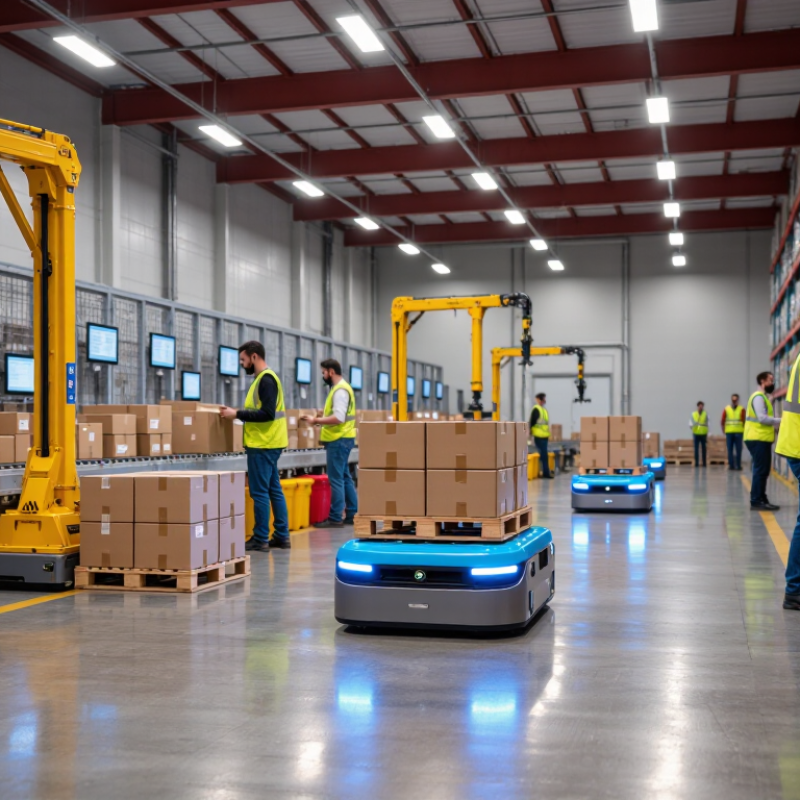
Logistics robotics is the use of programmable machines to move, handle, or process goods across supply chain operations. It includes mobile robots that carry totes, robotic arms that sort parcels, and automated systems that move pallets. Not magic. These tools perform repeatable physical tasks using sensors, software, and instructions connected to warehouse processes.
Their role is to keep materials flowing between receiving, storage, picking, packing, and dispatch. For example, a mobile robot can bring a shelf or tote to a worker, reducing long walks across a warehouse floor. A robotic arm can scan and sort parcels by size or destination. Small gains matter. Fewer unnecessary trips can help teams manage busy shifts, while clearer tracking can show where orders or inventory are waiting.
Robots do not manage a supply chain alone. They depend on accurate inventory records, reliable routes, maintained equipment, and people who can respond when something goes wrong. A blocked aisle or a mislabeled tote can disrupt a tidy workflow. That part is easy to underestimate. The best system is not always the most automated one; it is the one that fits the building, workload, and staff skills. Robotics can improve consistency, but companies still need to measure errors, delays, and worker feedback rather than assume every installation is a success.
Defining logistics robotics and its role in supply chains
Logistics robots—including autonomous mobile robots and automated guided vehicles—move goods within warehouses and distribution centers. Their growing use can help supply chains handle material flows more efficiently. The International Federation of Robotics reported nearly 113,000 transportation and logistics robots sold worldwide in 2023, up 35% year over year. The 2022 figure shown is an estimate derived from that rounded growth rate.
Source: International Federation of Robotics, World Robotics 2024; 2022 value calculated from reported 2023 sales and growth.
What Is the Future of Logistics Robotics in 2026?
The State of Logistics Robotics Entering 2026
Logistics robotics is moving from isolated trials into routine warehouse work. Mobile robots carry totes between storage aisles and packing stations, while automated systems handle repetitive sorting and pallet movement. Yet adoption remains uneven. Older buildings, changing inventory, and peak-season surges can disrupt carefully planned workflows. A robot may navigate a clear aisle well, then stall when a temporary cart blocks its route. Human teams still provide flexibility that machines struggle to match.
Tips: Start with one measurable bottleneck, such as long walking distances or repeated pallet transfers. Map the workflow before buying equipment, and test during a busy shift. Track exceptions, not just average speed. Small disruptions reveal more than a polished demonstration.
Entering 2026, the strongest operations are likely to combine automation with practical human oversight. Interoperability, maintenance access, and worker training matter as much as machine capability. Managers should also account for charging time, software updates, and changes to floor layouts. These details are easy to overlook. I would be cautious about treating a successful pilot as proof of warehouse-wide readiness; the conditions that made it work may not exist elsewhere.
| Dimension | State Entering 2026 | Likely Direction in 2026 | Operational Consideration |
|---|---|---|---|
| Market adoption | Global sales of professional service robots for transportation and logistics reached approximately 113,000 units in 2023, a 35% increase from 2022, according to the International Federation of Robotics. | Adoption is likely to continue expanding, particularly in warehouses and distribution centers, although growth will vary by region, facility type, and investment conditions. | Treat industry-wide sales as a market indicator, not a measure of robots installed or productivity at an individual site. |
| Mobile transport | Autonomous mobile robots (AMRs) and automated guided vehicles (AGVs) move goods within facilities. AMRs typically navigate dynamically, while many AGVs follow more predefined routes or guidance. | More deployments are likely to connect mobile robots with warehouse software, lifts, conveyors, and workstations to coordinate material movement. | Assess traffic flow, charging, pedestrian safety, connectivity, and integration with existing control systems. |
| Storage and retrieval | Automated storage and retrieval systems (AS/RS) are established options for moving and storing inventory in facilities designed or adapted for automation. | Interest is likely to remain strong where space utilization, order throughput, and predictable inventory movement justify the capital investment. | Evaluate building constraints, SKU profiles, peak demand, system availability, and recovery procedures before implementation. |
| Picking and handling | Robotic picking and piece handling are used for selected tasks, but performance depends on item variety, packaging, presentation, and the reliability of perception and gripping. | Progress is likely to be incremental, with systems focused on repeatable tasks and human-robot workflows rather than universal handling of every item. | Test against real inventory, including irregular shapes, reflective surfaces, soft packaging, and exceptions. |
| Sorting and parcel flow | Automated sortation is widely suited to high-volume operations with consistent processes and clearly defined destinations. | Facilities are likely to prioritize flexible configurations that can accommodate changing parcel volumes and product mixes. | Model peak-period capacity and exception handling, not only average daily throughput. |
| Software and interoperability | Robots depend on reliable coordination with warehouse management systems, warehouse control systems, fleet managers, and facility infrastructure. | Integration and fleet coordination are likely to become more important as sites operate multiple robot types and automation systems together. | Confirm interface requirements, data ownership, cybersecurity controls, and support responsibilities before deployment. |
| Workforce and safety | Robots are generally used to automate or assist with defined material-handling tasks; people remain important for supervision, replenishment, exception resolution, and maintenance. | Deployment plans are likely to place greater emphasis on worker training, safe traffic design, and clear task handoffs between people and robots. | Include worker consultation, risk assessment, training, and documented emergency procedures in project planning. |
| Return on investment | Financial results depend on labor and facility costs, utilization, maintenance, software, integration, and the proportion of work that can be automated. | More buyers are likely to compare automation options using site-specific lifecycle costs and measurable service outcomes rather than headline robot counts. | Measure throughput, order accuracy, uptime, labor hours, and total operating cost against a documented baseline. |
Note: The 2023 sales figure refers to professional service robots classified for transportation and logistics in the International Federation of Robotics’ World Robotics 2024 report. Statements about 2026 describe directional expectations, not guaranteed outcomes or quantified forecasts.
What will shape logistics robotics in 2026 is not one dramatic machine. It is the practical combination of mobile robots, machine vision, and fleet software. The International Federation of Robotics’ World Robotics 2024 – Service Robots report recorded about 113,000 professional service robots sold for transportation and logistics in 2023. Sales were 11% lower than in 2022. That matters. The figures are a reminder that adoption is uneven, and sales alone do not prove productivity.
Improved cameras and AI vision can spot crushed cartons, shifting pallets, and partly hidden labels. Robotic arms can use that information to pick mixed cases with fewer fixed guides. Fleet software can reroute robots around blocked aisles and balance work across zones. Digital twins can test peak-season traffic before teams change a warehouse layout. Still, autonomy is not solved. Reflective wrapping, poor lighting, and inaccurate maps can turn a smooth demonstration into a slow shift.
Tips: Pilot one congested workflow and measure travel time, failed picks, and worker interruptions. Keep a manual fallback. It is easy to overlook exceptions; track them before expanding, and check whether the robots improve the whole process, not just one task.
How Robots Are Changing Warehouses and Transport Operations
In 2026, logistics robots are becoming practical teammates, not science fiction. Autonomous mobile robots can carry totes between shelving and packing stations, while robotic arms handle repeatable carton moves. At busy loading docks, automated vehicles can shuttle pallets along marked routes. The International Federation of Robotics’ World Robotics 2024 report recorded 113,000 professional transport and logistics robots sold in 2023, a 35% increase from 2022. Growth is real, but robots still need clear routes, reliable data, and people ready to intervene.
Transport operations are changing too. Yard vehicles can move trailers between designated areas, and warehouse systems can coordinate tasks around arriving shipments. These tools may reduce walking and repetitive handling, but they do not fix poor layouts or late inventory updates. The weak point is often the handoff between software, equipment, and workers. That is easy to underestimate. A robot waiting beside a blocked aisle helps nobody.
Tips: Start with one predictable, high-volume route. Measure travel time, missed scans, and worker feedback before expanding. Keep a manual fallback; real warehouses are rarely as tidy as the floor plan.
Logistics robotics in 2026 will depend less on impressive demonstrations than on reliable performance during ordinary shifts. A robot must handle a scuffed floor, a blocked aisle, and inventory that changes without warning. Small failures add up. If workers repeatedly need to reset machines, promised efficiency can disappear.
Adoption barriers often begin with the building itself. Narrow routes, uneven surfaces, and older software can make integration costly. Managers also need clear evidence that equipment saves time without creating new bottlenecks. Safety planning should cover pedestrian crossings, emergency stops, charging areas, and what happens when sensors fail. These procedures need regular testing, not just a binder on a shelf. That detail is easy to miss.
Workforce effects will vary by site. Some employees may shift from moving loads to monitoring systems, resolving exceptions, or maintaining equipment. That requires paid training and a real path to competence, not a quick demonstration beside a noisy conveyor. Workers should help identify unsafe handoffs and awkward routes; they often see problems before dashboards do. The transition will not be perfectly smooth. A robot may reduce repetitive lifting, yet increase pressure to keep every task moving. Employers will need to measure both productivity and workload, then adjust staffing when the numbers tell an uncomfortable story.
It uses programmable machines to move, handle, or process goods. Examples include mobile robots, robotic arms, and pallet-moving systems. Not magic.
A mobile robot can carry a tote to a packing station, reducing long walks. Robotic arms can sort parcels by size or destination. Small gains matter.
No. They rely on accurate inventory records, clear routes, maintained equipment, and staff who can respond to problems. A blocked aisle can stop the flow.
Cameras and AI vision can detect damaged cartons and hidden labels. Fleet software can reroute robots around blocked aisles, while digital twins can test layouts.
Not necessarily. Poor lighting, reflective wrapping, or inaccurate maps can slow operations. Sales figures alone do not prove better productivity.
Pilot one busy, predictable workflow. Measure travel time, failed picks, missed scans, and worker interruptions before expanding. Keep a fallback.
Track delays, errors, and worker feedback. Check handoffs between software, equipment, and staff. I may be underestimating how messy those handoffs get.
As supply chains become faster and more complex, logistics robotics is evolving from a collection of automated machines into a connected system for moving, sorting, storing, and tracking goods. Entering 2026, warehouses and transport operations are increasingly using mobile robots, automated handling equipment, and intelligent software to support repetitive tasks and improve visibility. Advances in sensors, artificial intelligence, and communication technologies are helping robots respond more effectively to changing layouts, workloads, and operational needs.
What Is The Future Of Robotics In Logistics Industry depends not only on technical progress, but also on practical adoption. Robots can help organizations increase throughput, reduce physical strain, and make better use of space, while people continue to oversee exceptions, planning, and safety. High implementation costs, integration challenges, reliable performance, and clear safety procedures remain important considerations. Successful adoption will require thoughtful workforce training and cooperation between people and machines, allowing automation to improve operations while supporting a safe and adaptable workplace.
